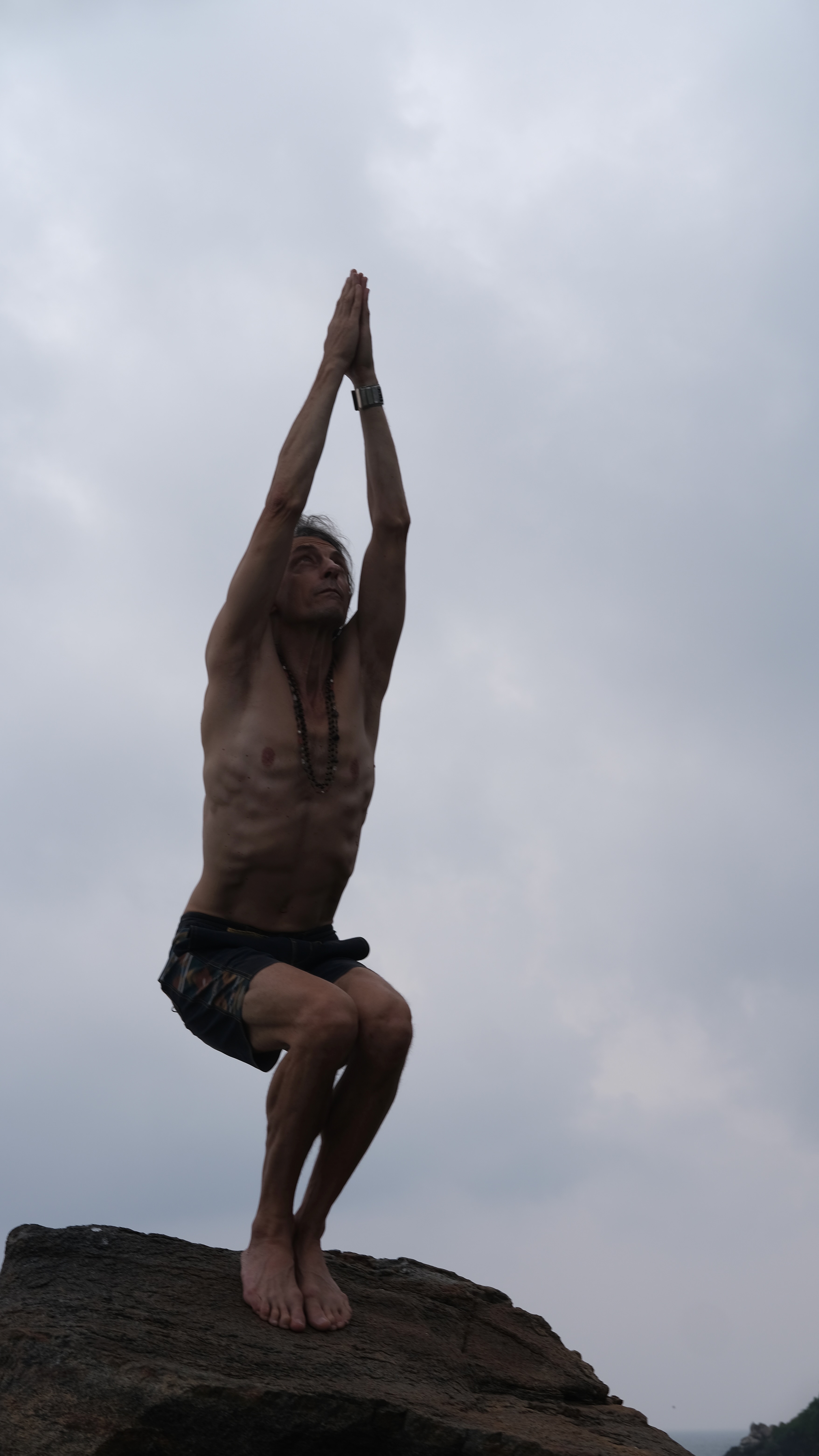
At root, Ashtanga is a basic practice. Not basic in the shallow sense — basic in the sense of foundational, repeatable, and designed for ordinary people with full lives and important responsibilities. It is a structured daily discipline that offers something profound: a scaled, accessible glimpse into the depth that ascetics and monastics spend lifetimes cultivating, made available through an hour of practice each morning. It was never meant for yoga stars. It was meant for the householder, the working person, the ordinary human being who wants to live with more awareness, strength, and clarity.
Over time, the culture around the practice distorted that simplicity. Ashtanga came to be seen as a highly advanced system — one reserved for unusually strong and flexible people — and advancement came to mean getting the next pose, moving to the next series, pushing always toward harder and more exotic challenges. Students absorbed the idea that the real value lives in the difficult, the flashy, the impressive. And in absorbing that idea, they began to skim past the foundation.
That is one of the most costly mistakes a practitioner can make.
Most of the value of this practice does not live in the advanced poses. Most of it lives in the basics: Surya Namaskara, the standing poses, Headstand, Shoulderstand, a simple seated forward fold. These poses are not throwaway poses. They are not filler. They are not what you rush through to arrive at the real work. They are the real work.
Triangle pose can be studied for a lifetime and not fully fathomed. Downward Dog can be studied for a lifetime. A standing forward fold is difficult. Jumping back to Chaturanga is difficult. Upward Dog is difficult. Not because they are exotic or impressive, but because they demand subtlety, skill, attention, curiosity, and years of honest practice. Their depth is easy to miss precisely because they do not look advanced. They look easy. And because their value is not placed on them, students assume deep study is not required. That is exactly wrong.
This is the first major shift in thinking that every serious practitioner needs to make: to appreciate the difficulty of basic things. To stop treating the foundation as something to get through and start treating it as something to get into.
Here is a structural fact that cannot be argued away: you cannot build a strong foundation by repeating poor versions of advanced poses. And you cannot master advanced poses without a strong foundation. These two facts together mean there is no shortcut in the equation. The foundation must be built. That progression must be honored.
The dominant approach in Ashtanga — try your hardest to do the most difficult version of the pose, every day, and trust that repetition will bring results — does not pan out. Trying hard is not the same as training intelligently. Repeating your best attempt at the hardest version of something does not gradually produce quality. It produces more deeply grooved versions of whatever you are already doing, good or bad. Practice only what you want to reinforce. What you repeat is what you become.
What is needed instead is a step-by-step, systematic approach through the foundational material — with full attention, full engagement, and the willingness to modify, prepare, and work incrementally. This is not the slow path. It is the direct path. It is the only path that actually arrives where you want to go.
There is a cultural and emotional dimension to this that needs to be named directly. Students are often conditioned to feel that doing anything other than attempting the hardest version of the pose is wrong — that they are slow, incompetent, or failing if they work in steps or reach for a prop. When asked to circle back to the foundations, they feel an aversion, because they have been taught, directly or indirectly, that these things are easy and should already be within reach, and that working this way means something is wrong with them — or that using props, steps, or modifications is simply not effective and veers off the proper Ashtanga path.
That interpretation is completely backwards. To be brought back to the foundation is not to be set back. It is to be placed in the most valuable part of the practice. If you need to work in steps on a jump back, or to use props in a forward fold, or to build up Chaturanga from a modified position — that is not a reflection of inadequacy. It is a reflection of seriousness. You are treating the pose with the respect it deserves. You are learning rather than performing.
The shame culture around working in the basics is one of the most harmful features of modern Ashtanga, and it is entirely without justification. Being asked to study something carefully is a gift, not a punishment. The teacher who keeps you in the foundation for months, or years, is doing you a great service — one that most students will not fully appreciate until much later, when the work done in those fundamentals begins to show up everywhere.
When the foundation is built honestly, two outcomes are possible. One: a practitioner develops a beautiful, deep, sustainable practice rooted entirely in the foundational material — Surya Namaskara done with full intelligence, the standing poses mastered over years, Headstand and Shoulderstand explored as the rich technologies they are. This practice is not lesser. It is not a consolation prize for people who did not make it to the advanced poses. It is whole, profound, and complete in itself.
Two: a practitioner uses that strong foundation to move into more complex postures with real integrity, real intelligence, and real benefit. The advanced poses — when they come — are built on ground that can actually support them. They do not create the hidden injuries, the foundational gaps, the future problems that come from reaching for complexity before the root is solid.
In either case, the root comes first. And the root remains essential — not a starting point you graduate from, but a living system you return to, for as long as you practice.
The invitation is simple, and it is a lifelong one: treat the basic poses as worthy of your deepest study. Bring to them the same curiosity, creativity, and care that you would bring to the most exotic posture in the series. Give them your full attention, your full intelligence, and your full respect. They will return the investment many times over — in health, in depth, in a practice that sustains you rather than depletes you.
The foundation is not the beginning of the practice. It is the practice.


Comments
No comments.